
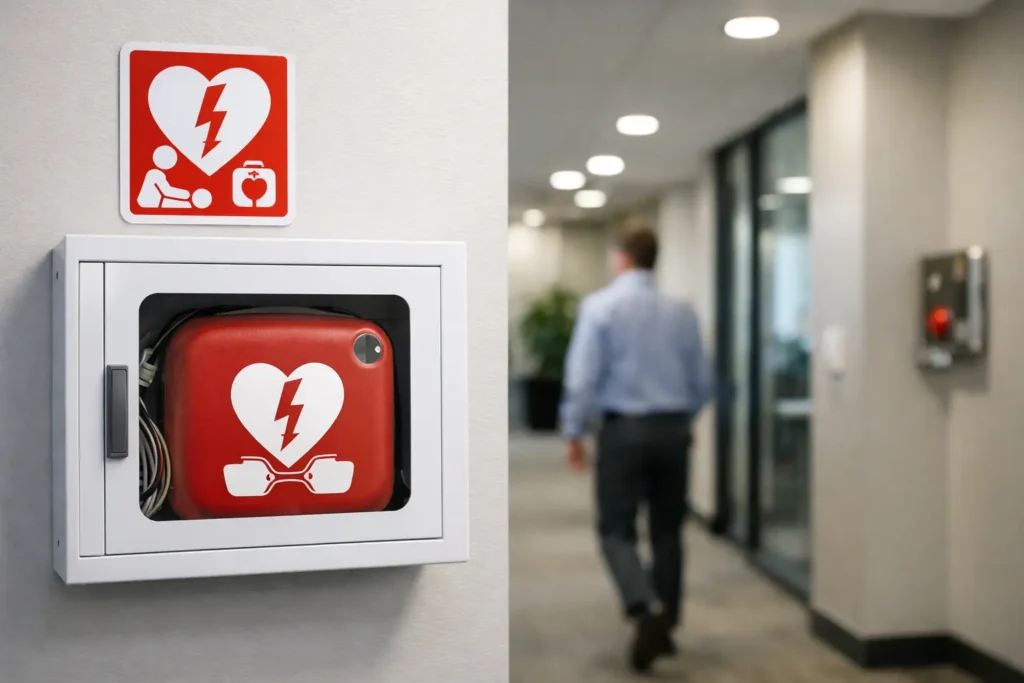
When someone collapses from sudden cardiac arrest, an AED that cannot be found quickly is not fully ready to serve its purpose. This AED signage requirements guide helps facility leaders make the device visible, accessible, and easy to locate under stress – whether it is placed in an office, school, church, manufacturing plant, recreation center, or public safety facility.
AED signage is more than a label on a cabinet. It is part of the response system that connects a bystander to lifesaving equipment in the minutes before EMS arrives. The best approach combines clear signs, thoughtful placement, trained responders, and ongoing AED program management.
There is no single federal rule that governs AED signs in every type of U.S. facility. Requirements can vary by state, municipality, occupancy type, building code, fire code, licensing standard, and the policies of the organization itself. Some state public-access AED laws address notification, maintenance, training, medical direction, or registration with local emergency services. Others may include placement or signage expectations.
For that reason, facility administrators should not treat a generic sign as proof of compliance. Review the AED requirements that apply where your organization operates, including any rules for schools, athletic venues, child care centers, health clubs, or public buildings. If your facility is leased, coordinate with the property manager as well. They may have rules affecting wall-mounted equipment, common-area signage, or emergency wayfinding.
A practical standard is simple: a person who has never visited the building should be able to identify that an AED is available and find it without asking for directions. That standard often goes beyond the minimum rule, and it is the right goal for emergency readiness.
Clear signs reduce hesitation. They should identify the AED using a widely recognized AED symbol and plain language, with enough contrast to be readable from a distance. A sign mounted directly above or on the cabinet tells people what they have found. Directional signs tell them how to get there.
For most organizations, effective signage includes three layers. The cabinet receives a visible AED identifier, the hallway or main traffic path has a directional sign, and building maps or emergency action plans show the device location. In larger facilities, use additional signs at decision points such as elevator lobbies, stairwell exits, reception areas, intersections, and entrances to gyms or auditoriums.
Sign size depends on the viewing distance, ceiling height, lighting, and the amount of visual clutter in the area. A small decal can work on the AED cabinet itself, but it will not help someone standing at the far end of a long hallway. Projecting signs that extend perpendicular to the wall are especially useful where people may approach from either direction.
Use durable materials that remain legible in the conditions of the space. An indoor office may need simple rigid signage. A pool area, industrial setting, outdoor venue, or unconditioned storage area may require materials that resist moisture, heat, cleaning chemicals, or fading. Replace signs that are damaged, covered, outdated, or obscured by seasonal displays.
An AED sign can be perfectly designed and still fail if it is hidden behind a door, shelving unit, banner, or open cabinet door. Walk the route yourself from the most common gathering areas. Then ask a staff member who was not involved in the AED placement decision to locate the unit using only the signs. Their experience will reveal gaps quickly.
Place the AED in a location that is accessible whenever the building is occupied. Avoid locked offices, staff-only rooms, closets, or areas that require a keycard unless your organization has a deliberate, documented response plan for that limitation. In many facilities, a centrally located, clearly marked cabinet near reception, a main corridor, a gym, cafeteria, break area, or high-occupancy space provides the fastest access.
There are trade-offs. A highly visible public location can improve access, but it may need additional protection from tampering or harsh environmental conditions. A secure location may protect the device, but it can delay retrieval. The right answer depends on the facility, its hours, the people present, and the anticipated response path. Signage should reflect that decision clearly.
A single AED may not be enough for a multi-floor campus or a large facility. Emergency response planning should account for walking distance, stairways, locked access points, building layout, and how long it takes to retrieve the device and return to the person in need. If an AED is located on another floor, directional signs must make that route obvious. In some cases, adding another AED is the better solution.
Schools and churches should also consider where people gather after normal business hours. A device placed near an administrative office may be hard to reach during evening practices, worship services, community events, or youth activities. Manufacturing sites should consider shift changes, large production areas, and restricted zones. Police and public safety agencies may need AED locations that support both facility response and vehicle deployment plans.
Signs are most effective when staff know what they mean and what to do next. During CPR and AED training, show participants the exact location of each device and have them practice assigning someone to retrieve it. A simple instruction such as, “Call 911, start CPR, bring the AED,” works best when everyone knows where “the AED” is.
Your emergency action plan should identify the AED location, who checks it, how staff contact emergency services, and how the organization handles post-incident follow-up. Make the plan available to employees, coaches, volunteers, security personnel, and others who may be present during an emergency.
For facilities with visitors, include AED locations on posted evacuation maps, visitor materials, and event setup plans when appropriate. This does not replace training, but it helps create awareness before an emergency occurs.
AED program management is not complete when the cabinet is installed. During routine AED readiness checks, inspect the surrounding signs along with the device status indicator, pads, battery, rescue kit, cabinet alarm, and expiration dates. Confirm that the AED has not been moved and that furniture, construction, or room changes have not made the location harder to see.
A simple inspection record should note whether signage is present, readable, and correctly positioned. This is particularly valuable after renovations, relocations, or changes in building use. It also helps new safety coordinators understand the system they are inheriting.
If your organization operates multiple locations, standardize sign design and placement practices where possible. Consistency helps employees who move between sites recognize an AED location quickly. Still, avoid a one-size-fits-all placement plan if the layouts and hazards differ significantly.
The goal of AED signage is not merely to satisfy a checklist. It is to help an employee, student, congregant, visitor, or responder act without losing precious time. A visible sign, a reachable cabinet, current supplies, and trained people work together as one emergency response system.
Square One Medical can help organizations align AED placement, signage, staff training, and ongoing equipment checks into a practical preparedness plan. The best time to test whether people can find your AED is during a routine walkthrough, not during the emergency that makes it necessary.