
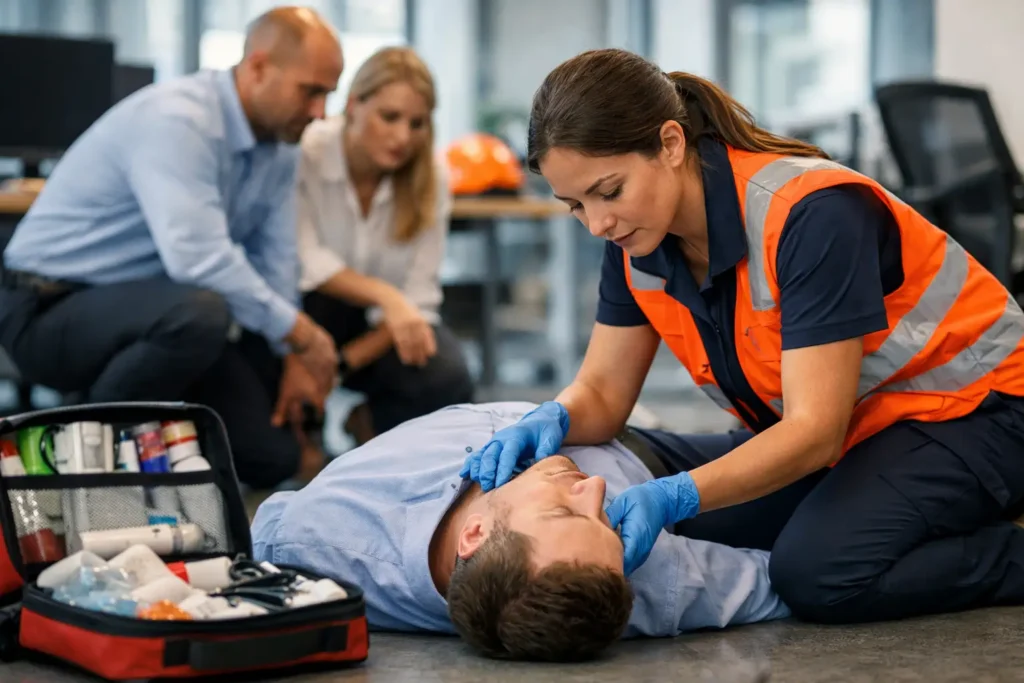
A medical emergency at work rarely arrives with warning. It might be a fall in a warehouse, a staff member with chest pain in an office, or a parent collapsing during a school event. In those first few minutes, the question is not whether help is coming. It is whether the people already on site know what to do.
That is why first aid training matters beyond compliance. For organizations, it builds a practical response capability that can protect employees, visitors, students, and congregants before EMS arrives. It also gives staff the confidence to act, which is often the difference between hesitation and a coordinated response.
Many organizations start with training because they need to meet a policy, licensing, or job requirement. That is a valid reason, but it should not be the only one. The strongest programs treat first aid training as part of a broader emergency readiness plan.
A good course prepares people to recognize common emergencies, assess the scene, call for help, and provide immediate care within their level of training. That may include bleeding control, shock response, burns, sudden illness, allergic reactions, and injury management. When CPR and AED instruction are included alongside first aid, teams are better prepared for the incidents that carry the highest risk.
For employers and facility leaders, that broader view matters. Training is most effective when it reflects the environment. A manufacturing site may need stronger emphasis on trauma response and incident coordination. A church or school may focus more on cardiac arrest, falls, and medical events involving guests or older adults. An office may need staff who can respond calmly to choking, fainting, or a sudden collapse in a common area.
First aid training becomes far more valuable when it is paired with accessible, maintained emergency equipment. The most obvious example is the AED.
In a cardiac arrest, every minute counts. Staff cannot benefit from AED instruction if the device is hard to locate, not maintained, or missing current pads and batteries. On the other hand, placing an AED without training people to use it creates a false sense of preparedness. The two should work together.
This is where many organizations run into a gap. They schedule training once, place equipment in a hallway, and assume the program is complete. In reality, readiness requires follow-through. AED cabinets need proper placement. Pads and batteries have expiration dates. Staff turnover changes who is trained. Emergency plans need to be clear enough that people can act under pressure.
For schools, churches, workplaces, and public facilities, AED program management helps close that gap. It keeps devices inspection-ready, supports replacement planning, and makes sure equipment remains usable when it is needed most. First aid training is not separate from that system. It is one of the core parts of it.
Not all training is equally useful in the real world. For an organization, convenience matters, but so does relevance.
The best first aid training is practical, hands-on, and easy to implement across teams. Staff should leave knowing how to recognize an emergency, who takes charge, where equipment is stored, and how to respond until EMS arrives. A class that checks a box but does not improve confidence has limited value.
Scheduling also matters more than many leaders expect. If training is hard to arrange, it gets delayed. If staff have to travel across town in staggered groups, it disrupts operations. Onsite options often make more sense for organizations because they reduce downtime and let teams train in the environment where they would actually respond.
Credibility matters too. A provider should be able to support more than the class itself. Many organizations need help aligning training with AED placement, replacement supplies, emergency response planning, and ongoing equipment oversight. Working with one experienced partner is usually simpler than piecing together training from one source and readiness support from another.
A strong program should reflect the risks, layout, and population of the facility.
In workplaces, first aid training often supports OSHA-minded safety planning, incident response, and team confidence. In industrial and manufacturing environments, the pace and physical nature of the work can make immediate response especially important.
In schools, staff may need to respond not only to employees but also to students, parents, and visitors during sports, dismissal, or after-hours events. Training needs to account for both routine medical issues and low-frequency, high-impact emergencies.
In churches and community organizations, responders are often helping large groups that include children, older adults, and guests unfamiliar with the building. Clear AED placement and trained volunteers can make a major difference during services or events.
In law enforcement and public safety settings, first aid training may intersect with trauma kits, overdose response equipment, and rapid scene coordination. The training is still foundational, but the equipment and response expectations may be more specialized.
Some organizations only need a small number of certified staff. Others want wider coverage across shifts, departments, or campuses. There is no single model that fits everyone.
The trade-off is straightforward. Minimum compliance may reduce short-term cost and scheduling pressure, but it can leave response capability thin when key people are absent. Broader training creates stronger coverage and often improves confidence across the organization, though it requires more planning.
The right choice depends on your facility, staffing, hours of operation, and public access. A small office may not need the same training footprint as a school district or multi-building church campus. Still, most organizations benefit from thinking beyond the bare minimum. Emergencies do not happen according to the org chart.
First aid training works best when it is treated as an ongoing program instead of a one-time event. Certifications expire. Staff roles change. Equipment needs service. Emergency plans should be reviewed as facilities grow or operations shift.
A durable approach usually includes regular training intervals, documented AED checks, replacement schedules for pads and batteries, and a clear understanding of who responds in an emergency. It also helps to standardize equipment across locations when possible, especially for organizations managing multiple buildings.
For decision-makers, the goal is not to become medical experts. It is to make emergency readiness easier to manage and more reliable in practice. That means reducing friction, keeping equipment current, and making sure staff know how to respond without confusion.
Square One Medical supports organizations with that full picture in mind, from hands-on training to AED program support and equipment readiness. For many teams, that kind of continuity is what turns a set of requirements into a working safety program.
First aid training is one of those investments that proves its value in a moment no one schedules. When that moment comes, prepared people and ready equipment can change the outcome.