
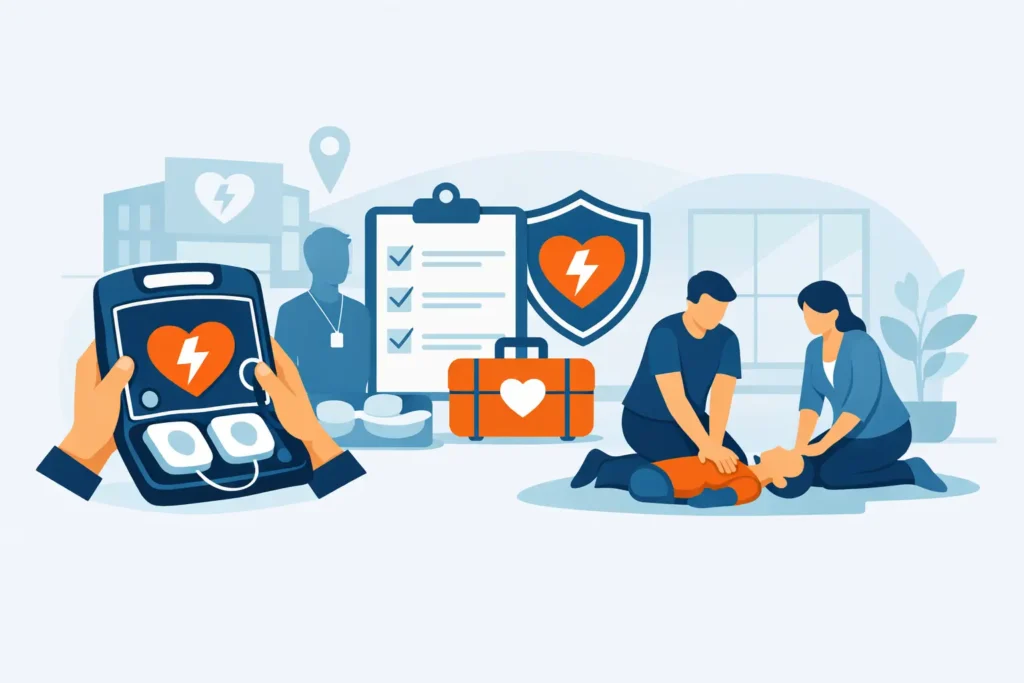
A cardiac emergency does not wait for a budget cycle, committee meeting, or staff training date. If you are the person responsible for safety at a workplace, school, church, or public facility, learning how to start AED program planning usually begins with one simple question: if someone collapses here tomorrow, are we ready to respond?
The right AED program is not just about buying a device and mounting it on a wall. It is about making sure the equipment is placed well, people know how to use it, and the program stays ready month after month. That is where many organizations get stuck. The good news is that building a practical, compliant, and manageable program is very achievable when you take it step by step.
Start with your environment, not the product. An office with 40 employees on one floor has different needs than a church campus, a manufacturing facility, or a school with athletics. The first decision is not which AED to buy. It is where risk exists, how many people are on site, how quickly emergency medical services can reach the building, and how large the space is.
A thoughtful site assessment helps you determine the number of AEDs needed and where they should go. In many facilities, the goal is to place an AED so it can be retrieved and brought to a victim within a few minutes. Large campuses, multi-story buildings, gyms, warehouses, and areas with public traffic may need more than one unit. If your organization serves older adults, has strenuous physical activity, or operates in a remote area, faster access matters even more.
At this stage, it also helps to identify who will own the program internally. Sometimes that is HR, sometimes facilities, sometimes a school nurse, athletic director, or safety coordinator. Someone needs clear responsibility for equipment checks, training records, and replacement supplies.
Once you understand your facility, choosing equipment becomes easier. Most modern AEDs are designed for bystanders and provide voice prompts, visual guidance, and automatic rhythm analysis. For many organizations, ease of use is the top priority because the responder may not be a medical professional.
That said, there are trade-offs. Some AEDs offer more advanced features, stronger durability, or better support for harsh environments. A climate-controlled office may do well with a standard wall-mounted setup, while a plant floor, athletic field, or police vehicle may need more rugged equipment and different storage options. Pediatric capability may matter for schools, childcare settings, and churches with children’s ministries.
The lowest upfront price is not always the lowest long-term cost. Pads and batteries expire, cabinets may be needed, and accessories such as signage, rescue kits, or alarmed storage can improve readiness. A strong program looks at the full lifecycle, not just the initial purchase.
An AED that is technically on site but hard to access is not doing its job. Place units in visible, central, and unlocked locations whenever possible. High-traffic common areas, near gymnasiums, main hallways, front offices, cafeterias, and security stations are common choices. In larger buildings, spread access points so one side of the facility is not relying on a distant unit.
Clear signage is part of placement. In an emergency, no one should have to ask where the AED is. If your building has visitors, volunteers, substitute staff, or rotating personnel, visible placement becomes even more important.
If you want people to use an AED confidently, training matters. Even though AEDs are built to guide users, hands-on CPR and AED instruction improves response speed, reduces hesitation, and helps teams work together under stress. For employers and institutions, this is where an AED program becomes more than a compliance purchase.
Your training plan should reflect your environment. An office may focus on designated responders across departments and shifts. A school may include nurses, coaches, administrators, front office staff, and security. A church may want pastors, ushers, childcare workers, and volunteers trained. Manufacturing and industrial sites often need broad coverage across multiple shifts and areas of the building.
It also helps to think beyond the first class. Certifications expire. Staff turnover happens. New hires come in. Without a plan for refreshers and recertification, readiness fades faster than most organizations expect.
An AED program works better when people know exactly what to do after someone collapses. Keep procedures practical. Who calls 911? Who starts CPR? Who retrieves the AED? Who meets EMS at the entrance? In schools and larger facilities, who manages crowd control or communicates with leadership?
You do not need an overly complex emergency manual, but you do need a clear response flow. A short written protocol, staff awareness, and occasional drills can make a major difference. This is especially important in settings with visitors or public events, where emergencies may involve people not known to staff.
One of the most common mistakes in AED program management is assuming that once the unit is installed, the job is done. It is not. Pads and batteries expire. Cabinets get blocked. Devices are moved, and no one updates the map. Monthly checks get skipped when responsibilities are unclear.
A good maintenance process is simple and consistent. Assign ownership, document checks, and track expirations before they become urgent. Many organizations benefit from AED management support because it reduces the chance of missing a deadline or finding out too late that supplies need replacement.
This is also where program partners can add real value. A full-service provider can help with equipment selection, placement guidance, training, replacement consumables, and ongoing tracking. That approach is often easier than trying to manage products, certifications, and compliance across multiple vendors.
If you are still wondering how to start AED program implementation, think in phases. First assess the site. Then choose the right equipment and placement. Train the people most likely to respond. After that, put a maintenance system in place that your organization can actually sustain.
The ideal program is not always the biggest one. It is the one your team can support consistently. A smaller organization may begin with one well-placed AED, trained staff, and a reliable maintenance plan. A larger campus may need multiple units, structured drills, and a broader response team. Both can be effective if they are built around realistic use.
For organizations in Pennsylvania and Ohio, working with a provider that can support both equipment and training can make the process more manageable from day one. Square One Medical helps many facilities take that all-in-one approach, especially when they want fewer handoffs and clearer accountability.
Starting an AED program is really about reducing the gap between an emergency and action. When the right equipment, training, and follow-through are in place, your facility is not just better equipped. It is better prepared to help save a life.