
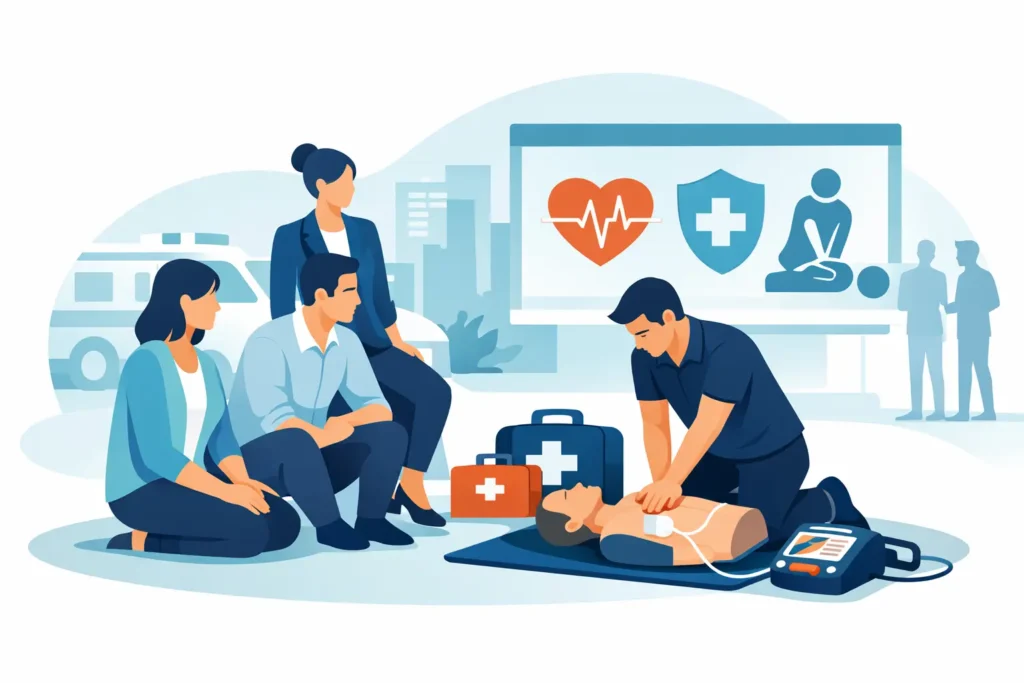
When a medical emergency happens, the first few minutes are rarely calm, and they are never theoretical. That is why a bls provider course matters so much for organizations that need people to respond quickly, communicate clearly, and use CPR and an AED with confidence.
For many employers and facility leaders, the real question is not whether training is valuable. It is whether Basic Life Support is the right level of training for their staff, how it differs from standard CPR, and how it fits into a broader emergency readiness plan. Those details matter, especially if you are responsible for safety, compliance, scheduling, and equipment readiness all at once.
A BLS provider course is designed for people who may need to recognize life-threatening emergencies and respond using high-quality CPR, rescue techniques, and AED use. It typically goes beyond a basic community CPR class by emphasizing team dynamics, scene coordination, and a more structured clinical response.
That makes it a strong fit for healthcare workers, dental offices, outpatient settings, school nurses, athletic trainers, and other professionals who may be expected to act in a medical emergency as part of their job. In many cases, the course includes adult, child, and infant CPR, bag-mask techniques, relief of choking, and multi-rescuer response.
The biggest difference is not just the skills list. It is the standard of response. A BLS class prepares participants to perform under pressure, often alongside others, with fewer delays and better role clarity.
This depends on the environment and the duties of your staff. If your team works in direct patient care or in roles where a higher level of emergency response is expected, a BLS provider course is often the right choice. Healthcare employers usually require it because it aligns better with clinical expectations than a basic CPR course.
For schools, churches, offices, manufacturing sites, and community organizations, the answer is more situational. Some staff members may need BLS, while others may only need CPR and AED certification. A school nurse or athletic department may benefit from BLS-level training, while front office staff may not need that same depth.
This is where many organizations waste time and budget. They enroll everyone in the same course without looking closely at actual responsibilities. Better planning usually leads to a better training mix and a more practical response program.
Training is only part of the response chain. If your facility has an AED, or should have one, your emergency planning should connect the bls provider course to AED placement, maintenance, and response protocols.
In a real event, even well-trained staff can lose time if the AED is hard to find, the pads are expired, the battery is nearing end of life, or no one knows who is responsible for checks. That is why organizations get better results when training and equipment planning are handled together.
A BLS-trained team should know where the AED is located, how to access it quickly, and what to do after use. Just as important, leadership should know the device is ready to perform. AED program management helps close that gap by keeping cabinets, pads, batteries, signage, and inspections aligned with the training your staff receives.
Most people want practical training, not a lecture-heavy session that feels disconnected from real emergencies. A good BLS provider course focuses on hands-on skill practice and realistic response scenarios. Participants should leave understanding not just what to do, but how to do it quickly and correctly.
That usually includes CPR technique, AED operation, ventilation skills, choking response, and coordinated team actions. Depending on the setting, the training may also address the flow of a workplace or facility response, including who retrieves the AED, who calls 911, and who meets EMS.
For employers, convenience matters too. Onsite training can reduce scheduling friction and make instruction more relevant because scenarios can reflect your environment. A dental office, school, church, or manufacturing site does not experience emergencies in exactly the same way, so context improves retention.
There is no benefit in overtraining people for roles they do not perform, but there is real risk in undertraining the people who will likely be first to respond. That is the trade-off.
A standard CPR and AED course is often the right solution for general workplace teams, teachers, coaches, ministry staff, and office personnel. It gives people the essential lifesaving skills they need without the extra depth meant for healthcare response.
A BLS provider course makes more sense when staff members are expected to respond in a professional capacity, use team-based resuscitation skills, or meet employer or licensing requirements. If you are unsure which course fits, start with the roles, the level of public access in your facility, and the likely emergency scenarios.
Certification is necessary, but preparedness is broader than a card or completion record. If your staff is trained but your AED program is neglected, your emergency response still has a weak point. If your AED is current but no one feels confident using it, that is another weak point.
The strongest programs treat training, equipment, and maintenance as one system. That includes selecting appropriate AEDs for your environment, placing them where they can be reached fast, tracking pad and battery expiration, and making sure trained responders stay current.
For larger organizations or multi-site operations, this becomes even more important. Schools, churches, manufacturers, and public-facing facilities often benefit from a structured AED management process because turnover, changing schedules, and multiple buildings can create gaps quickly.
The best training plan is the one your team can actually maintain. That means choosing the right level of certification, scheduling it in a way that minimizes disruption, and pairing it with equipment support that does not leave staff guessing later.
For many organizations, that starts with a simple review of who needs BLS, who needs CPR/AED, where AEDs should be placed, and who is checking readiness over time. A one-stop training and equipment partner can simplify that process because you are not trying to coordinate instructors, devices, replacement supplies, and compliance tasks through separate vendors.
A bls provider course is not just a class choice. It is part of how your organization prepares to protect employees, students, patients, members, and visitors when seconds matter. The most useful next step is to match the training to the real demands of your environment and make sure your AED program is ready to support it.