
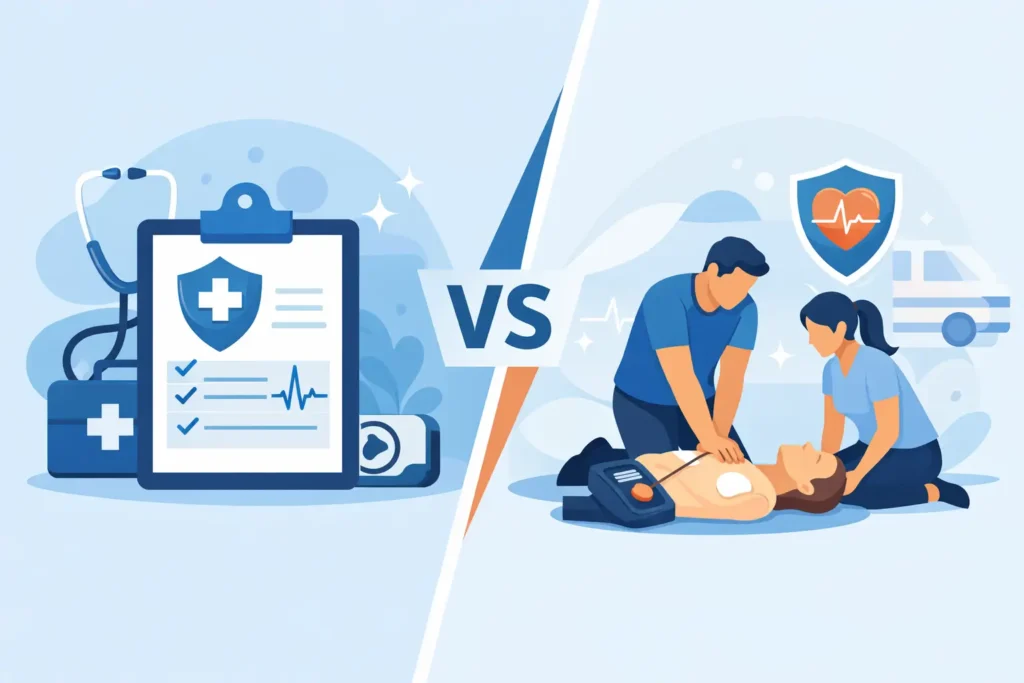
If you’re scheduling training for staff and trying to sort out bls certification vs cpr certification, the wrong choice can create real problems. You might enroll a healthcare-facing team in a general CPR class that does not meet job requirements, or pay for BLS training when a standard CPR and AED course would fully cover your workplace needs. The difference matters because certification should match the role, the setting, and the level of response expected.
At a high level, CPR certification is a broader category. It typically teaches how to respond to cardiac arrest, use an AED, and provide basic first aid for choking and other common emergencies. These courses are often designed for workplaces, schools, coaches, childcare staff, churches, and community groups.
BLS certification, which stands for Basic Life Support, is more specific. It is generally intended for healthcare providers and professional responders who may need to perform CPR in clinical or high-acuity settings. BLS covers high-quality CPR too, but it usually goes deeper into team-based response, ventilation skills, and care for adults, children, and infants in a more structured medical context.
That means BLS is not simply a “better” version of CPR certification. It is a different level of training for different responsibilities.
For many organizations, standard CPR and AED certification is the right fit. Office teams, manufacturing staff, school personnel, church volunteers, fitness professionals, and facility managers often need practical emergency response training without the clinical depth required in a hospital or patient-care environment.
This kind of course is built around what most lay responders are likely to face: recognizing sudden cardiac arrest, calling 911, starting chest compressions, using an AED, and helping someone who is choking. In many cases, that is exactly what an employer needs to strengthen workplace readiness.
It also pairs naturally with AED placement. If your staff are being trained to respond before EMS arrives, they should know how to use the device installed in your building. That is especially relevant in workplaces, schools, churches, and public facilities where a fast AED response can make a measurable difference.
BLS certification is commonly required for nurses, physicians, medical assistants, EMTs, dental professionals, and students in healthcare programs. If a licensing board, hospital system, clinic, or employer specifically says BLS is required, a general CPR course usually will not satisfy that requirement.
The reason is straightforward. Healthcare professionals may be expected to work as part of a coordinated response team, manage airway support, and deliver CPR with a higher level of precision and role clarity. BLS training is designed for that environment.
Some non-hospital roles also fall into this category. For example, certain law enforcement units, occupational health teams, or onsite medical staff may need BLS depending on their protocols and scope of responsibility. The key question is not what sounds more advanced. It is what your job requirement actually calls for.
There is some overlap between the two, which is why people often confuse them. Both CPR certification and BLS certification generally include adult CPR, AED use, and choking response. Both are focused on helping someone survive a life-threatening emergency in the first critical minutes.
The difference is in depth and context. CPR courses for lay responders are usually centered on confidence, recognition, and fast action. They teach people how to step in safely and effectively until professional help arrives.
BLS courses generally add more emphasis on two-rescuer CPR, team dynamics, bag-mask ventilation, and a more formal approach to infant and child resuscitation. The pace can be more rigorous because the learners are often expected to use those skills in a professional setting.
For employers, the best choice often comes down to compliance, risk profile, and the environment where an emergency could happen. A front office, warehouse, church campus, or school building usually benefits most from CPR and AED certification for a broad group of staff. That approach is practical, cost-conscious, and easier to roll out across departments.
If your team includes licensed clinicians or designated medical responders, BLS may be necessary for those individuals while the rest of the staff complete CPR and AED training. That mixed approach is common and often makes more sense than putting every employee through the same course.
This is also where AED program planning matters. Training is only part of readiness. The other half is making sure your AEDs are placed appropriately, visible, maintained, and supported with current pads, batteries, signage, and response procedures. A certification card is valuable, but it works best when paired with equipment that is ready to use.
Start with the job description, not the course title. If a regulatory body, healthcare employer, or academic program requires BLS, that decision is already made. If there is no formal requirement, look at the kind of emergency your team is most likely to face and what role they are expected to play.
For most non-clinical workplaces, CPR and AED certification is the right baseline. It prepares staff to recognize cardiac arrest, act quickly, and use the AED on site. For schools and churches, that can be especially important because the people present may include children, older adults, and visitors with unknown medical histories.
Then think operationally. Do you need onsite training to reduce disruption? Do you need help certifying a large group on a recurring schedule? Do you also need AED cabinets, replacement pads and batteries, or support tracking expirations? Those details can have just as much impact on readiness as the course itself.
One of the most common mistakes is assuming that any CPR card works everywhere. It does not. A healthcare employee who needs BLS may not be covered by a general CPR course. On the other hand, a workplace may overcomplicate training by selecting BLS when a standard CPR and AED class is more appropriate and easier for staff to retain.
The better approach is to match the training to the role and build a response program around it. That may include certification, AED placement, equipment checks, replacement consumables, and a simple plan for who responds, where the device is located, and how EMS is activated.
When training and equipment are aligned, people respond faster and with more confidence. That is the goal. Whether you choose CPR certification, BLS certification, or a combination of both, the right program is the one your team can use when the moment is real.