
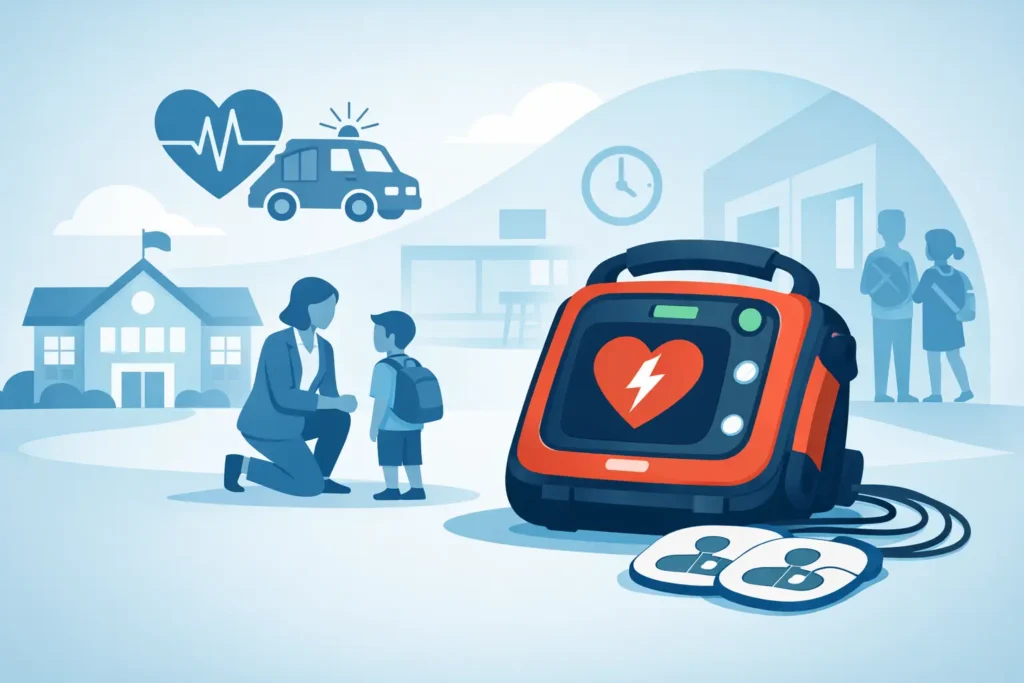
A student collapses during basketball practice. A staff member goes down in the hallway. A parent has a medical emergency during a school concert. These are the moments behind the question, why do schools need AEDs? Because sudden cardiac arrest does not wait for an ambulance, and schools are responsible for hundreds or even thousands of people every day.
An AED, or automated external defibrillator, gives school staff a way to respond in the first few critical minutes of a cardiac emergency. It is designed to be used by ordinary people, not just medical professionals. When paired with CPR and a clear emergency response plan, an AED can make the difference between a survivable event and a tragedy.
Schools are public spaces with a wide mix of ages, health conditions, and activity levels. Students, teachers, coaches, volunteers, visitors, and family members all move through the building each day. That means the risk is not limited to one group.
A common misconception is that AEDs are only necessary in hospitals, gyms, or senior-focused facilities. In reality, sudden cardiac arrest can affect teens, adults, and children. Student athletes may have undiagnosed heart conditions. Staff members may have known or unknown cardiovascular risks. Visitors may experience an emergency during pick-up, performances, games, or school events.
The key issue is time. For sudden cardiac arrest, survival rates drop with each minute that passes without defibrillation. Even in districts with strong EMS support, response times are not always fast enough to cover the first few minutes. Large campuses, locked entrances, after-hours events, and crowded parking areas can all delay access.
That is why schools need AEDs on site, visible, and ready to use.
People often associate school AEDs with sports programs, and for good reason. Practices, games, conditioning sessions, and heat-related strain can increase the chance of a medical emergency being noticed on the field or in the gym. But focusing only on athletics misses the bigger picture.
Most school cardiac emergencies are not limited to student athletes. They can happen in classrooms, administrative offices, cafeterias, auditoriums, bus loading zones, and staff areas. A comprehensive school safety plan should reflect how the building is actually used, not just where the most visible physical activity happens.
This also matters for after-hours use. Many schools serve as community hubs. They host church groups, recreation leagues, voting, parent nights, performances, and public meetings. Once a school opens its doors to the public, the need for accessible emergency equipment becomes even more practical.
Because AEDs are built for guided use. Modern units provide voice prompts and step-by-step instructions so a responder can act quickly under stress. They analyze the heart rhythm and only deliver a shock if one is needed. That design helps reduce hesitation and supports safer intervention.
Still, the device alone is not the full answer. Training matters. Staff should know where AEDs are located, who is expected to respond, and how CPR and AED use fit into the school’s emergency action plan. In a real event, confidence comes from repetition, not from having equipment in a cabinet and hoping someone figures it out.
For administrators, that creates a practical planning question. Buying an AED is one step. Building a working AED program is what makes the investment meaningful.
A school can technically have an AED and still be poorly prepared if the unit is hard to reach. Placement should be based on response time, building layout, and event coverage.
In many schools, one front-office AED is not enough. Multi-story buildings, detached athletic facilities, large campuses, and spaces used after hours may require multiple devices. The goal is simple: get the AED to the victim fast, ideally within the first few minutes.
That may mean placing units near gyms, auditoriums, cafeterias, nurse offices, or main traffic corridors. It may also mean using cabinets with alarms, clear signage, and regular checks so the device is easy to find and ready when needed.
There is no perfect one-size-fits-all number. A smaller private school may need a different layout than a large public high school with athletic fields and separate buildings. The right setup depends on the campus.
Many administrators first ask about state requirements, and that is reasonable. AED laws vary by state, and school policies may be shaped by district rules, athletic association guidance, or local expectations. But compliance should be the floor, not the goal.
The stronger question is whether the school can respond effectively if an emergency happens tomorrow.
That includes making sure the AED is registered if required, staff are trained, replacement pads and batteries are tracked, and someone is responsible for oversight. Too often, schools purchase a unit, install it, and assume the job is done. Then years later, they discover expired consumables, missing documentation, or staff turnover that left no one prepared.
A managed AED program helps avoid that problem. Ongoing oversight keeps the device rescue-ready and reduces the chance that critical details are missed.
Every school leader balances budget, staffing, and competing priorities. AEDs are not the only safety investment a campus needs, but they address a high-consequence emergency where early action matters enormously.
From a risk management standpoint, AEDs show that a school has taken a reasonable step to prepare for a known medical emergency. That matters for student welfare, staff confidence, and community trust. Parents want to know their children are learning in a safe environment. Employees want to know their workplace is equipped to respond. Coaches and event staff want more than a 911 plan.
There is also a cultural benefit. When schools invest in CPR training, AED access, and emergency readiness, they reinforce that safety is operational, not just theoretical. Preparedness becomes part of how the organization functions.
A useful AED program is not complicated, but it does need structure. Schools do best when they treat AED readiness like any other critical safety system.
That means choosing the right devices for the environment, placing them where response times make sense, training staff across shifts and roles, and assigning responsibility for inspections and replacement schedules. Athletic staff, front office teams, school nurses, security personnel, and administrators should all know the plan.
It also helps to work with a provider that can support both equipment and training. That simplifies purchasing, rollout, and long-term maintenance. Instead of juggling multiple vendors, schools can build a more dependable process around one coordinated program.
For districts and private schools alike, that kind of support makes implementation easier and more sustainable.
Schools are expected to be ready for emergencies, not just academically prepared and operationally organized. An AED is one of the few tools on campus that can directly change the outcome of a sudden cardiac arrest in the time before EMS arrives. When schools put the right devices in the right places and back them up with training and program management, they give students, staff, and visitors something every community deserves – a better chance when seconds count.