
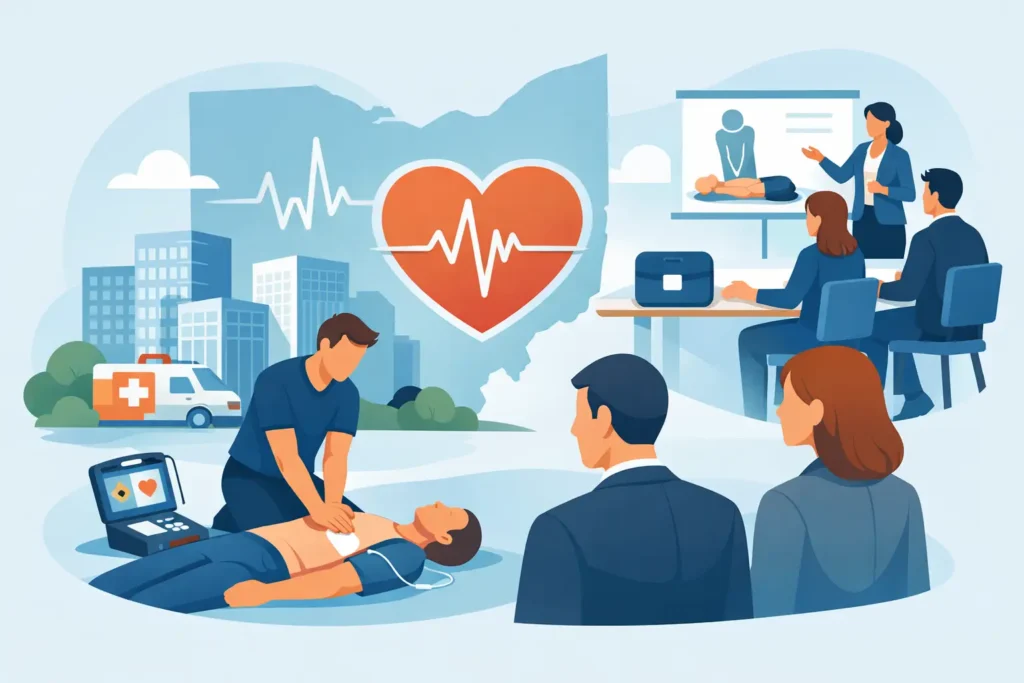
When an employee collapses in a break room or a visitor goes down in a church lobby, nobody gets extra time to figure out the plan. That is why CPR classes Ohio businesses invest in should do more than check a compliance box. They should help people respond quickly, use an AED with confidence, and support a workplace emergency plan that works under pressure.
For most organizations, the real question is not whether training matters. It is what kind of training makes sense for your team, your facility, and the level of risk you manage every day. A small office, a manufacturing floor, a school district, and a police department may all need CPR instruction, but they do not need the exact same program.
Good CPR training is practical first. Staff need to recognize cardiac arrest, call for help, start compressions, and use an AED without hesitation. If a class is too generic, too rushed, or disconnected from the realities of your workplace, retention suffers.
That matters because CPR and AED response are closely linked. Training staff without thinking through AED placement, battery life, pad expiration, or who will maintain the device leaves a gap in the system. On the other hand, buying an AED without training people to use it can create false confidence. The best approach brings both pieces together.
For many employers, onsite training is the most efficient option. It keeps teams together, reduces travel time, and lets instruction fit your actual environment. In some settings, location-based classes are still the better choice, especially for smaller groups or organizations with shifting schedules. It depends on team size, staffing patterns, and how much flexibility you need.
An office may focus on visitor safety, medical emergencies, and giving front-line staff enough confidence to act before EMS arrives. A warehouse or manufacturing site may need stronger emphasis on coordinated response, scene safety, first aid, and AED access across a larger footprint. Schools and churches often need broader training coverage because the public is present and response roles may involve staff, volunteers, or ministry leaders.
This is where many safety programs either become useful or become paperwork. If training is selected only because it is cheap or available fast, it may not reflect your staffing reality. If it is built around your environment, it becomes easier to assign responders, place AEDs intelligently, and build a response plan people can actually follow.
Cardiac arrest response is not only about CPR technique. Early defibrillation is often the difference between a recoverable event and a fatal one. That is why AED placement in workplaces, schools, churches, and public facilities deserves as much attention as class scheduling.
A common mistake is assuming one AED near the front desk covers the whole building. In a compact office, maybe it does. In a plant, school campus, or large worship space, maybe it does not. Response time matters, and placement should reflect foot traffic, travel distance, and where physically demanding activity happens.
AED readiness also has an administrative side. Pads expire. Batteries have replacement cycles. Cabinets, signage, and alarmed storage can improve visibility and access. If no one owns those details, devices can drift out of readiness even when everyone believes they are protected. That is why AED program management matters. A training provider that also understands equipment support can save organizations from juggling multiple vendors and multiple points of failure.
Not every team needs the same type of class. Some roles require formal certification for OSHA, job requirements, licensing, or internal policy. Others simply need practical emergency response skills. The right answer depends on your industry, your liability considerations, and who is expected to respond.
Certification courses are often the right fit for designated responders, safety staff, coaches, school personnel, and teams with documented compliance needs. Skills-focused sessions can still be valuable for organizations that want broader awareness across the workforce. In many workplaces, a blended approach works best – certify core responders and give additional staff basic exposure to CPR, AED use, and first aid procedures.
That approach usually improves coverage without forcing every employee into the same training track. It also respects scheduling realities, which is often what slows safety programs down in the first place.
Before scheduling a class, it helps to look beyond the course title. Ask how the training fits your industry, whether onsite delivery is available, what credentials are issued, and how hands-on the class will be. You should also ask how the provider handles AED support if you already have devices or plan to add them.
This is especially relevant if your organization is replacing older AEDs, adding cabinets, updating pads and batteries, or building a multi-site response plan. CPR instruction is strongest when it is part of a larger preparedness program rather than a one-time event. That does not mean every business needs a complex system. It means your training, equipment, and maintenance process should make sense together.
For Ohio employers managing multiple locations, consistency matters too. Different sites may have different risks, but training quality, AED standards, and recordkeeping should be easy to manage. Safety coordinators and HR teams usually do not need more vendors. They need fewer moving parts.
The class is not the finish line. Once staff are trained, the next step is making sure your emergency response setup supports what they learned. That may mean reviewing AED placement, checking supplies, assigning internal contacts, or deciding who tracks expiration dates and replacements.
In many organizations, this follow-through is where readiness either improves or fades. People leave training feeling prepared, but six months later the pads are near expiration, new hires have not been trained, and nobody is sure who has the cabinet key. A simple management process prevents that.
That is one reason many businesses prefer a partner that can train teams, provide AEDs, support trade-ins, and help manage ongoing readiness. Square One Medical works with organizations that want that kind of practical support, especially when they need both training and equipment handled in one place. It is a cleaner way to build confidence across facilities without creating extra administrative burden.
CPR training is valuable on its own, but it becomes far more effective when paired with the right AED strategy and a clear maintenance plan. If your team is due for training, this is a good time to ask a bigger question: if an emergency happened at your facility this afternoon, would your people know what to do, and would your equipment be ready when they reached for it?
That answer is worth getting right before anyone needs it.