
Now for a limited time, trade in your old AED for a generous rebate toward a new unit!
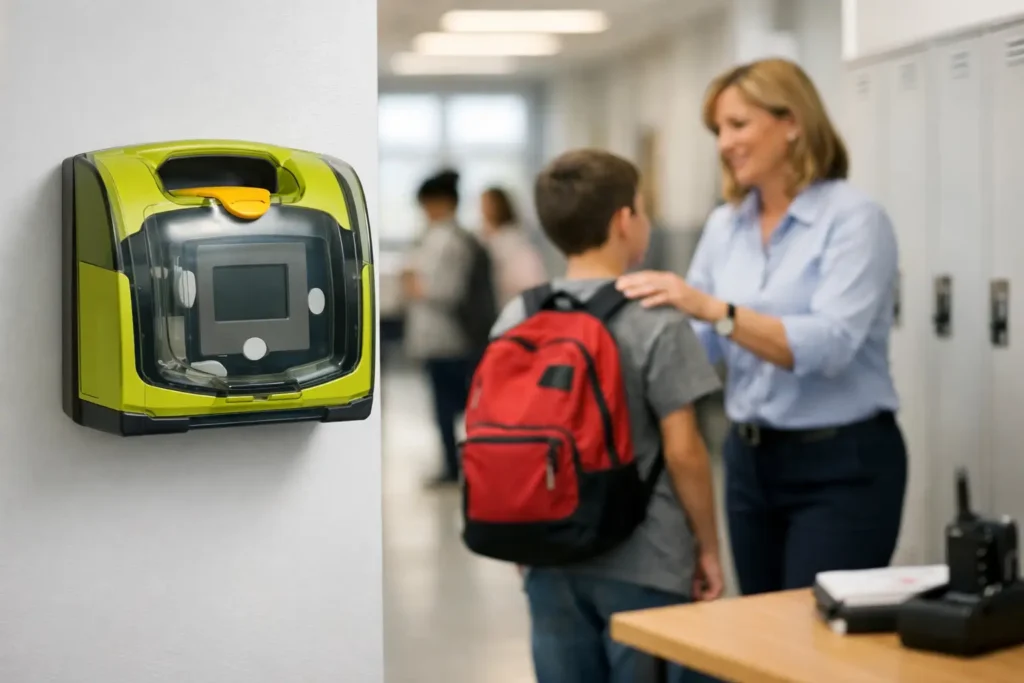
A cardiac emergency on a school campus will not wait for a nurse’s office to open, a coach to return from the field, or emergency services to arrive. School AED policies turn the presence of an AED into a coordinated response: someone calls 911, someone retrieves the device, trained responders begin care, and staff guide EMS to the patient. That level of readiness protects students, staff, visitors, and families when minutes matter most.
An AED program is more than a device mounted in a cabinet. It is a living safety system with clear ownership, reliable equipment, trained people, and procedures that work during a stressful event. The best policy is practical enough for staff to follow without hesitation and detailed enough to keep the program ready throughout the school year.
Sudden cardiac arrest can affect people of any age and may occur during athletics, assemblies, classes, performances, or community events. An AED can analyze a heart rhythm and, when appropriate, deliver a shock that may help restore a normal rhythm. It provides voice and visual prompts designed to guide a responder, but fast access remains essential.
A school may have an AED on site and still face avoidable delays if staff do not know where it is, access is restricted after hours, pads have expired, or no one has responsibility for checking the unit. Written school AED policies close those gaps. They establish the decisions that should not have to be made during an emergency.
Policies also create continuity. Administrators, nurses, athletic directors, coaches, facilities teams, and front-office staff can change from year to year. A documented program keeps AED readiness from depending on one knowledgeable employee.
A useful policy starts by mapping the campus, not by copying a generic document. Consider where people gather, how far a responder must travel, which buildings are used after school, and where emergency vehicles can enter. A compact elementary school may need a different approach than a multi-building high school, a sprawling college campus, or a district facility with athletic fields separated from the main building.
AEDs should be visible, accessible, and placed where staff and visitors can reach them quickly. Common locations include main entrances, cafeterias, gymnasiums, auditoriums, nurse’s offices, and athletic areas. An AED stored inside a locked office can be less useful than one in a clearly marked cabinet along a public corridor.
Outdoor fields deserve special attention. If practices and games occur far from the building, a response plan may require an AED at the field, with a trained coach or event staff member assigned to bring it. The right answer depends on distance, staffing, weather exposure, and facility use. It should be tested by walking the route, not estimated from a floor plan.
Your policy should identify each AED location, the cabinet access method, signage expectations, and the process for moving a device temporarily for an event. It should also specify how staff will direct EMS to the exact location of an incident.
An AED program needs an owner, but it should never have only one capable person. Designate a program coordinator and a backup responsible for monthly checks, supply replacement, documentation, and communication with school leadership. The school nurse may be a natural clinical resource, yet the policy should account for times when the nurse is absent or assigned elsewhere.
The response plan should state who calls 911, who retrieves the AED, who starts CPR, who meets EMS, and who manages students or bystanders nearby. Those roles do not need to be rigid. In a real emergency, the nearest able staff member should act. Still, discussing responsibilities in advance reduces confusion and helps teams work together.
CPR and AED training gives staff the confidence to respond before EMS arrives. Schools should consider the people most likely to be present across the day and during extracurricular activities: administrators, office personnel, teachers, coaches, security staff, facilities personnel, transportation teams, and activity leaders.
Training should reflect the campus environment. A coach may need to retrieve an AED from a field-side cabinet, while a receptionist may be responsible for calling 911 and directing responders through a secured entrance. Hands-on practice allows staff to rehearse those responsibilities instead of simply reading them.
Students can also play a role in preparedness when age-appropriate education is included in the school’s safety culture. They should know how to alert an adult, call 911 when directed, and help identify the location of an AED. They should not be expected to replace trained adult leadership, but informed students can help shorten the time to action.
A policy should call for periodic drills that include the full chain of response. Run a scenario in the gym, on the football field, in the cafeteria, or during an evening event. Time how long it takes to recognize the emergency, call 911, retrieve the AED, begin CPR, and meet EMS.
Drills often reveal practical issues: a cabinet is blocked by furniture, a door is locked after hours, staff are unsure which entrance EMS should use, or the AED is farther away than expected. Those findings are valuable. Update the placement plan and procedures based on what the drill shows.
An AED is only ready when it is maintained. Modern units perform automated self-tests, but they still require routine visual inspection and documented oversight. Pads and batteries have expiration dates. Pediatric pads, if included in the program, must be compatible with the device and available where they are needed. Cabinets, alarms, signage, and wall mounts also need attention.
School AED policies should require a scheduled inspection, typically monthly or according to the manufacturer’s guidance and local requirements. The inspection record should confirm that the device’s status indicator shows readiness, the cabinet is accessible, supplies are present, and expiration dates are tracked. If a unit signals a fault, the policy should explain who is notified and how a replacement device is made available.
This is where AED program management can remove administrative pressure from school staff. Expiration tracking, replacement planning, inspection support, and centralized documentation help prevent a device from becoming an overlooked piece of equipment. It is especially helpful for districts managing multiple buildings and athletic sites.
AED laws and school requirements vary by state and district. A policy should align with applicable state requirements, local EMS guidance, school board procedures, and the manufacturer’s instructions for the specific AED model. Depending on the jurisdiction, this may include physician or medical direction, EMS notification or registration, training standards, and reporting expectations after use.
The policy should also address communication with families, staff, and the community after a serious event. Privacy must be respected, while school leadership still needs an internal process for documenting what occurred, replacing used supplies, downloading device data when appropriate, supporting affected staff and students, and reviewing the response.
A post-event review is not about assigning blame. It is an opportunity to identify what worked, where response time was lost, and what the school can improve before another emergency occurs.
The strongest school AED policies are reviewed before each school year and whenever buildings, staffing, activities, or device locations change. They are shared with the people expected to use them, not filed away for an accreditation visit. A short orientation for new staff, reminders before sports seasons, and visible AED signage can make a meaningful difference.
Square One Medical helps organizations pair hands-on CPR/AED training with AED program management, equipment support, and practical placement guidance. For school leaders, that integrated approach can simplify a responsibility that touches facilities, health services, athletics, administration, and family trust.
A well-maintained AED and a practiced response team give a school community something valuable: a clear plan for acting quickly when a life may depend on it.