
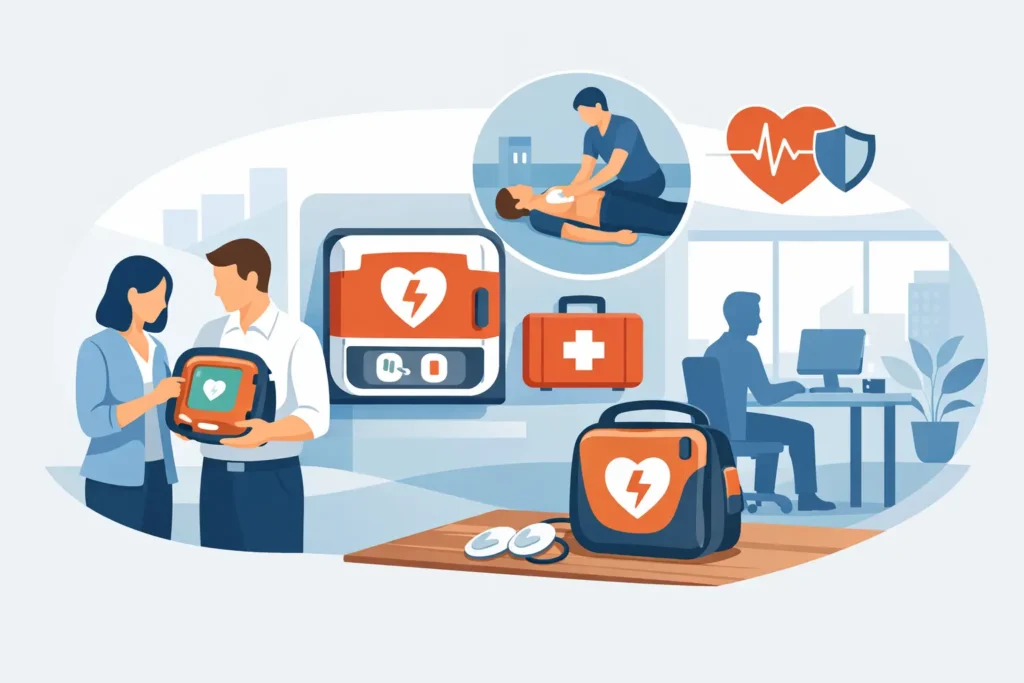
When an AED is needed at work, nobody cares which model had the best brochure. What matters is whether it is close enough, ready to use, and simple enough for a stressed employee to trust in a real emergency. That is the practical lens to use when thinking about how to choose workplace AEDs.
For most organizations, the right choice is not just about the device itself. It is about matching the AED to your building, your people, your response plan, and your ability to keep the unit rescue-ready over time. A lower upfront price can look appealing, but it may create more work later if replacement parts are harder to manage or if the unit is less intuitive for untrained responders.
Start with the setting. An office with one floor and a small staff has different needs than a manufacturing facility, school campus, church, warehouse, or police department. The best AED for your workplace is the one that can be reached quickly and used confidently within the first few minutes of a cardiac emergency.
That usually means asking a few basic questions first. How large is the facility? How many people are typically onsite? Are there visitors, students, members, or customers in addition to staff? Are there multiple shifts, locked areas, loud environments, or outdoor spaces that affect access? Those details shape placement, quantity, cabinet options, and whether features like enhanced durability or clearer visual prompts matter more.
An AED should also fit the likely user. In many workplaces, the first person on scene will not be a medical professional. It may be an office manager, coach, teacher, usher, supervisor, or security staff member with basic CPR training. That is why ease of use matters so much. Voice prompts, clear electrode placement guidance, and simple readiness indicators can make a real difference when adrenaline is high.
Not every workplace needs the same feature set, but a few factors deserve close attention.
A device can look straightforward in a product description and still feel confusing in an emergency. Look for AEDs with calm, direct voice instructions and a layout that helps users move step by step without hesitation. If your organization has turnover or relies on a broad group of potential responders, usability should carry a lot of weight.
Every AED needs ongoing attention. Pads and batteries expire, status checks need to be completed, and accessories may need replacement after use. Some units make that process easier than others. If you want a reliable program, choose an AED that your team can realistically maintain, or work with a provider that offers AED program management and expiration tracking.
This is where the cheapest option is not always the least expensive over time. Consumable costs, replacement schedules, and administrative burden all affect total cost of ownership.
Some workplaces serve children even if they are not schools. Churches, community centers, athletic programs, and family-facing businesses should think carefully about whether pediatric pads or settings are needed. For adult-only workplaces, this may be less urgent, but it is still worth reviewing based on who enters the building.
An AED placed in a climate-controlled office lobby has different demands than one mounted near a gym, loading area, shop floor, or patrol vehicle. Dust, temperature swings, moisture, vibration, and heavy traffic can influence which unit and cabinet setup make the most sense. In tougher environments, durability is not an extra. It is part of readiness.
This is one of the most common questions, and the answer depends on response time more than headcount alone. A single AED may be enough for a small office, but larger facilities often need multiple units so a responder can retrieve one and return quickly. If your building has several floors, separate wings, or areas with restricted access, relying on one centrally mounted device may leave part of the workplace underserved.
Placement should support a fast response, with visible cabinets and signage that employees can identify immediately. In many cases, organizations benefit from walking the site as if an emergency were happening right now. If it takes too long to reach the AED, unlock a door, or cross the facility, placement likely needs adjustment.
If you are deciding how to choose workplace AED equipment, do not separate the purchase from the training plan. The two should support each other.
A workplace with regular CPR and AED training may be able to manage a broader range of options because responders are more familiar with the process. A site with limited training participation or frequent staff turnover usually benefits from the most intuitive unit possible. Either way, the goal is the same: reduce hesitation and help people act.
This is also why many organizations prefer to work with one partner for both equipment and training. It simplifies implementation, supports consistency, and makes it easier to build a response program instead of just checking off a purchase.
Buying an AED is only the first step. Ongoing readiness is what protects your investment and, more importantly, your people.
A strong AED program includes routine checks, documented maintenance, current pads and batteries, and a clear plan for what happens after a unit is used. Some organizations manage this internally without trouble. Others find that a managed approach saves time and reduces the chance that something gets missed.
Support matters here. If you have questions about placement, accessory replacement, software updates, or trade-in options, it helps to work with a provider that stays involved after the sale. For workplaces in Pennsylvania and Ohio, having access to training, equipment, and program support through one source can make emergency readiness much easier to manage.
Before you choose, compare AED options through the lens of your actual workplace, not an ideal one. Think about who will use the device, where it will be stored, how it will be maintained, and whether your team will feel confident when it is needed. The right AED is the one your staff can find fast, use correctly, and keep ready without unnecessary friction.
That decision gets easier when you treat the AED as part of a larger preparedness program. A well-placed unit, supported by training and ongoing management, gives your workplace something more valuable than a product. It gives people a clearer chance to help when every second matters.
If you are weighing options, take the extra time to choose for usability, coverage, and long-term support rather than price alone. The best workplace AED choice is the one that works in real life, on an ordinary workday, when nobody has time to figure it out.