
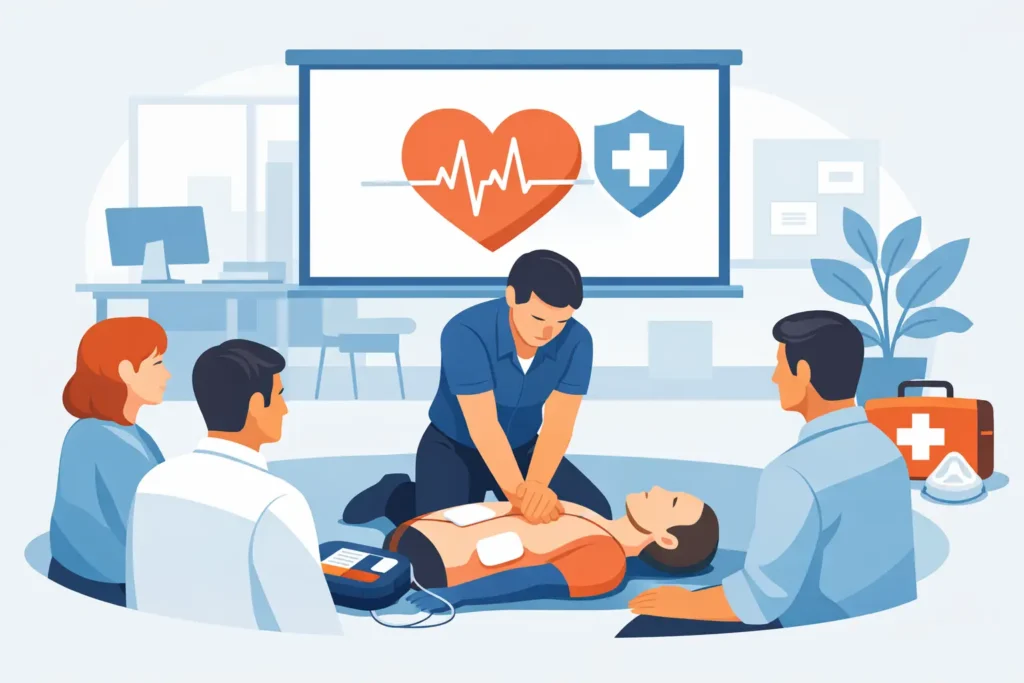
When an employee collapses, nobody gets extra time to compare training options or figure out whether the AED is up to date. That is why a workplace CPR certification guide matters most before there is ever an emergency. For employers, HR teams, school leaders, and facility managers, the goal is not just checking a compliance box. It is building a response that people can actually use under pressure.
The first question is not simply, Do we need CPR training? In most organizations, the better question is, Who needs training, how often, and what else has to be in place for that training to matter? A certified team without an accessible AED, current pads and batteries, or a clear response plan is still operating with gaps.
A strong workplace CPR certification guide should help you evaluate training scope, scheduling, certification requirements, and equipment readiness together. That is especially important in workplaces with larger campuses, shift-based staffing, public-facing spaces, athletic programs, or higher-risk environments such as manufacturing floors and church or school facilities.
Some organizations pursue CPR certification because an industry standard, insurer, or internal policy calls for it. Others take action after a close call. Either way, the smartest place to start is a basic risk review.
Consider how many people are in the building each day, how physically demanding the environment is, how far the nearest EMS response may be, and whether visitors, students, members, or customers are regularly on site. A small office may need a different training cadence than a warehouse, a private school, or a church with weekend crowds. The number of trained responders, the placement of AEDs, and the type of first aid support you need can vary quite a bit.
That trade-off matters. Training everyone can create broad coverage and confidence, but it may be harder to schedule and renew. Training designated responders is often more manageable, but only if those people are consistently present across shifts and locations.
CPR and AED response should be treated as one program, not two separate purchases. In a cardiac arrest event, CPR keeps blood moving, but early defibrillation is often what gives a victim the best chance of survival. That means training staff to recognize sudden cardiac arrest and use an AED quickly is just as important as teaching compressions.
For many employers, this is where planning gets uneven. The organization schedules a CPR course, but the AED is mounted in the wrong place, the cabinet is not alarmed, replacement pads are expired, or no one is tracking battery life. A workplace CPR certification guide should account for the full response chain, because equipment readiness can make the difference between a fast rescue and a delayed one.
AED placement should reflect how people actually move through the space. High-traffic areas, gyms, fellowship halls, front offices, manufacturing areas, and larger multi-floor buildings may need different placement strategies. If your team serves the public, hosts events, or operates across several buildings, one AED may not be enough.
Not every workplace needs the same delivery model. Onsite CPR training is often the best fit for employers who want minimal disruption, consistent instruction, and easier scheduling for groups. It also allows the instructor to address real site conditions, including where AEDs are located and how your staff would respond in your actual building.
Offsite classes can work well for smaller teams or organizations with more flexible staffing. The key is making sure the certification type matches the role. Some workplaces need standard CPR and AED instruction for staff readiness, while others may need a more formal occupational training track that includes first aid and meets specific employer or jobsite requirements.
Hands-on skills practice still matters. Even if part of the course content is delivered efficiently, people retain more when they physically perform compressions, practice AED pad placement, and work through realistic response steps. In a real emergency, familiarity reduces hesitation.
A card on file does not guarantee a strong emergency response. Employers also need a practical internal plan. Who calls 911? Who starts CPR? Who retrieves the AED? Who meets EMS at the entrance? In larger facilities, these details should be assigned and practiced, not assumed.
This is where many safety programs improve quickly with small changes. Posting AED locations, documenting response roles, checking devices monthly, and tracking consumable expirations can turn basic compliance into real preparedness. The best programs are not the most complicated. They are the ones people can follow without confusion.
For schools, churches, and public-facing organizations, this matters even more because the person in distress may not be an employee. Your response plan should reflect staff, visitors, students, congregants, and community members who use the facility.
Once initial training is complete, maintenance becomes the real test. Certifications expire, staffing changes, and AED components age out whether they are used or not. If nobody owns the follow-up process, readiness slowly slips.
A practical workplace CPR certification guide should include renewal timing, roster management, AED inspection routines, and a process for replacing pads, batteries, cabinets, or trauma supplies as needed. It should also account for organizational growth. If you add a building, expand a shift, or host larger events, your original training and AED plan may no longer be enough.
Many organizations benefit from having one partner handle both training and equipment support. That reduces handoffs and makes it easier to keep certifications current while also managing AED placement, device updates, and supply replacement. Square One Medical often supports employers in that exact way, especially when they want to simplify readiness instead of managing separate vendors.
Before scheduling training, ask whether the provider can support both certification and long-term AED program management. Ask how onsite sessions are structured, whether the training fits your industry, and how equipment maintenance is handled after purchase. If you already have AEDs, ask whether replacement pads, batteries, cabinets, and compliance support are available.
The best provider is not always the one offering the fastest class or the lowest initial price. It is the one that helps your organization stay ready six months and two years from now. For employers in Pennsylvania and Ohio, that can be especially valuable when coordinating multi-site teams or recurring certification cycles.
A good emergency response program should feel usable, not overwhelming. If your team knows what to do, your AEDs are ready, and your training schedule is manageable, you have already removed some of the biggest barriers to action. When the stakes are that high, practical readiness is what counts.